

Austin-based independent artist Hoxsey has carved a unique position in the alternative music scene by blending very story-driven songwriting with indie rock and gothic moods, punk attitude and experimental soundscapes. Hoxsey treats his music as an open personal diary, capturing fleeting emotions and immortalizing them in dark, cinematic compositions that refuse to be confined by traditional genre borders. In his seminal collaboration with Peppermilk, Hoxsey takes this theatrical style and elevates it to a lush sound and story tapestry, populating his creative world with traveling circuses, forgotten towns, and enigmatic performers. His discography is a map to wandering the stranger parts of the human experience, making music that is comfortably nostalgic and refreshingly new, as it welcomes the ghosts and memories that won’t go away.
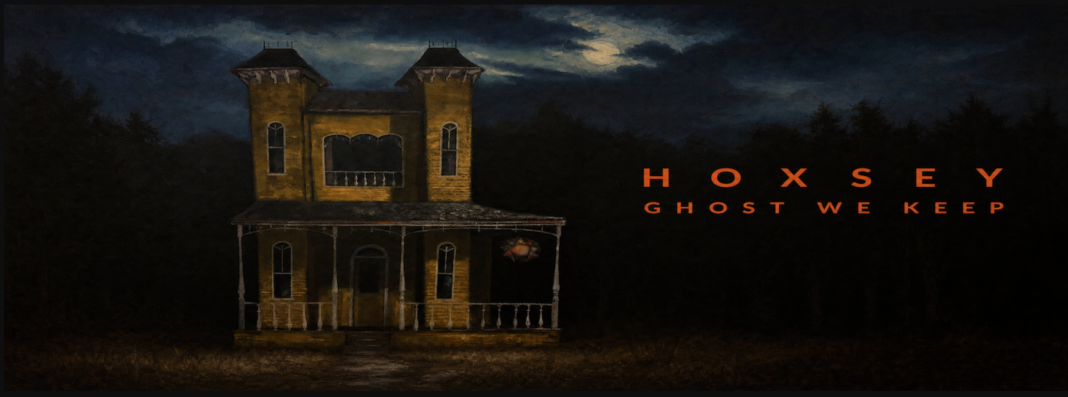
Building upon this theatrical foundation, Hoxsey’s eleven-track album Ghost We Keep unfolds as an atmospheric voyage through dirt roads, carnivals, and the quiet burdens carried by every human spirit. Conceived not as a simple seasonal novelty but as an early autumn reflection on memory, mortality, and identity, the record boldly establishes its own living universe. Hoxsey has an ambitious vision for the project, famously describing it as “the classic Halloween album for the next 50 years.” At its central core, the album delivers a comforting and profound message: the lingering ghosts trailing behind us—our past mistakes, lost relationships, and buried anxieties—are not curses to be banished but essential companions on the wandering road of life.
The entry into this spectral universe begins with “Skeleton Key,” a composition that operates as a psychological key designed to open the long-locked sections of inner grief. There’s a subtle theatrical tension to the song’s deliberately unsettling, almost villainous cheerfulness of the atmospheric arrangement, a tension that reveals our natural fear of looking inward. In this potent opening statement, Hoxsey tells us that real emotional healing can never start until we give our secret memories and hidden anxieties permission to come out into the open and talk.
Moving naturally from the threshold of inner reflection into physical motion, “The Road” serves as the foundational anchor for the entire record. Written and recorded almost entirely inside the solitary confines of a traveling vehicle during a personal move back east—tracing paths through Philadelphia, a chance back-alley encounter in Savannah, and studio sessions in New Orleans—the track encapsulates the central message of the album. Hoxsey illustrates that moving across state lines does not erase emotional baggage, as physical travel merely changes the landscape surrounding our past. The highway becomes an eternal channel of transition where the human spirit wrestles with the dual desire to run from heartbreak while stepping into an uncertain future.
“Josaphina” takes its time observing human connection on this highway and turns the view into a character portrait of quiet vulnerability and lasting dignity. The narrative is centered on a delicate, insistent figure trying to make her way through a cruel world, and it illuminates unseen spirits carrying heavy historical loads in silence but also displaying a surprising warmth, even in decay. The song is a tender reflection on the listener, as it suggests that a piece of Josaphina exists within everyone, a gentle presence, trying to preserve beauty in the face of a world that crumbles softly in the background.
“Charm Cider” is a sensorial preservation of warmth, like an early autumn elixir distilled to withstand an approaching emotional winter, after the tender intimacy of individual character portraits. The song captures the urgency of holding onto fleeting moments of comfort and locking them away safely before the seasonal changes take hold. The track shows us that sweet memory is still the ultimate medicine able to thaw the coldest corners of human isolation as it looks for solace in small, tangible recollections.
The Introduction Of Sgt. Capone
“The Introduction Of Sgt. Capone” is a dramatic leap into clever satire, inspired by a real world sighting of a small dog swaggering with a Napoleon-like personality, who is actually a reincarnation. Hoxsey expands this eccentric spark into a sharp anti-war commentary and an examination of the theatrical armors people construct for self-preservation. Beneath the grand bravado of a swaggering military figure lies a fragile truth: behind our aggressive public personas and performative shields, most people are simply protecting a vulnerable heart that fears being truly known.
“Pixelated Whorror” extends the boundaries of contemporary alienation, highlighting the artificial distortions of modernity when the ancient fears of man are projected on digital screens. The track investigates the distortion of isolation and memory in screen-lit solitudes and forewarns of the slow vanishing of real human contact. Hoxsey shows how this loss of the organic connection causes ordinary internal anxieties to rise behind artificial filters, turning simple memories into unnatural, digital haunts.
A Ride With The Four Horsemen in 1888
“A Ride With The Four Horsemen in 1888” takes an epic historical turn into existential storytelling, moving the narrative into a dust-swept, late-nineteenth-century horizon where mortality and the passage of time are directly confronted. The song reveals that after a humbling realization, all souls are riding along with the relentless march of time no matter what time it is, what status you have or what ego you possess. To accept the fact that life on earth is limited is not a tragedy but an inevitable, grounding truth that unites all who are on the journey of life.
The “Corpses Ball Room” is the emotional and personal climax of the album, where every ghost, every mistake, and every lost memory mentioned throughout the record is invited to a big dance of liberation. The track celebrates the final end of a relationship and the complex emotions it leaves behind, a space where lingering specters are no longer feared or banished. When we open our arms to the heartbreaks of the past, we find a great sense of freedom. It is when our inner baggage is finally given a room to dance that the spirit is freed from its self-imposed hauntings.
Traveling carnivals, historical horizons, and gothic folklore provide lush imagery in Ghost We Keep, but the message hits home for our routines and personal lives. We all commute on our own quiet transit lines to work, to manage relationships, to wear masks of confidence, or to fritter away hours in front of the digital screen. We walk around our days with secret fears and silent heartaches and pretend armor just to get through. With Hoxsey’s album, we are reminded that we don’t have to pretend that we are perfect or that we have no past. Real peace comes when we stop running from our past and accept our memories as colorful threads that add to the story we are living.
To experience Ghost We Keep at its absolute best, it should be heard during a quiet early autumn evening, ideally at twilight or during a nighttime drive along an open road with a quality pair of over-ear headphones. Allowing the album to play straight through from “Skeleton Key” to “Corpses Ball Room” lets the narrative unfold like a cinematic audio drama. Ultimately, Hoxsey and Peppermilk have made an extraordinary piece of storytelling, emotional honesty and creative ambition. Ghost We Keep turns internal anxiety into theatrical characters and heartbreaks into celebratory dances but leaves a lasting impression. The ghosts we carry along the way are the very things that make the human journey beautiful.
For more songs like this, follow Hoxsey on Spotify, Hoxsey on Soundcloud, Hoxsey on Facebook, Hoxsey on Instagram, beacons.ai