


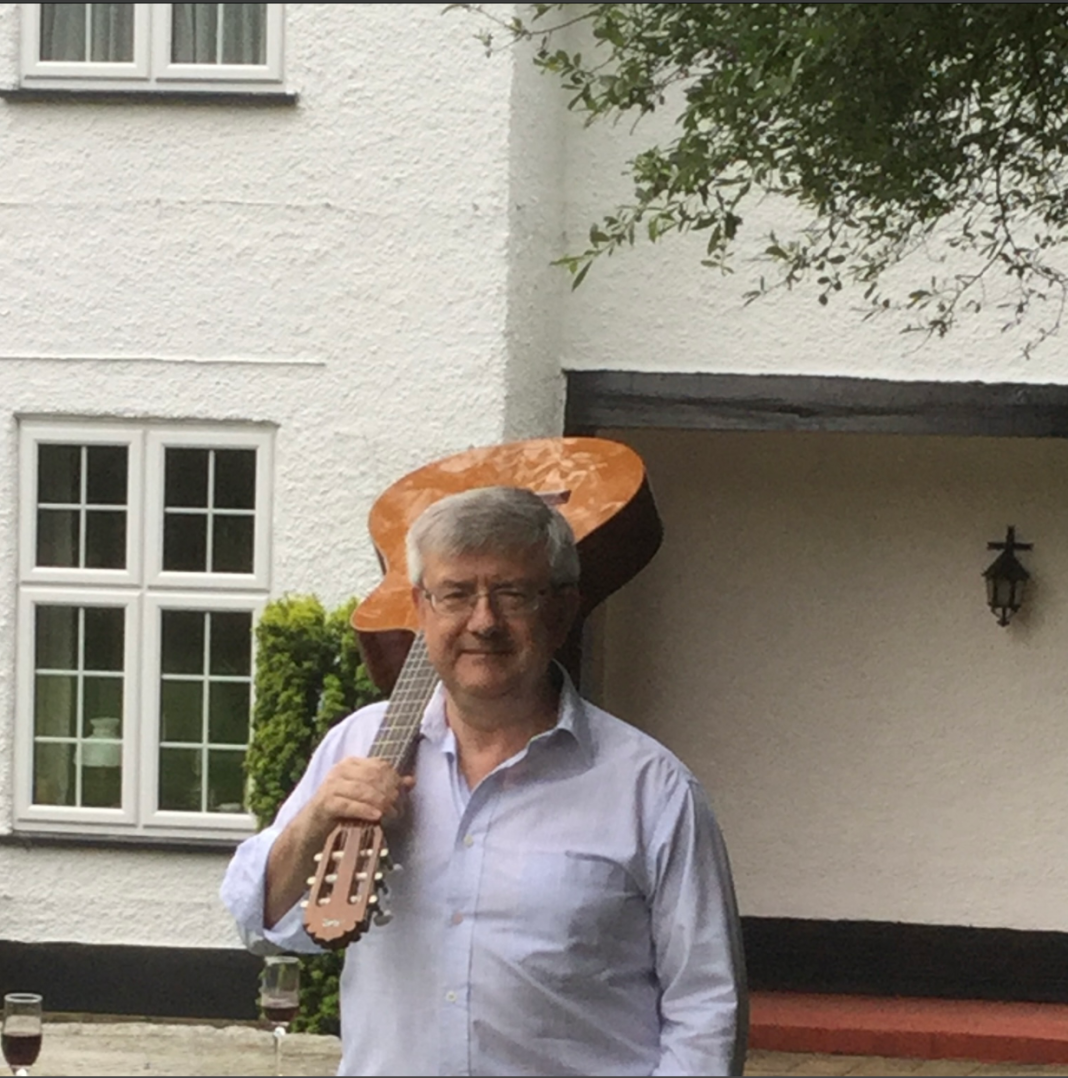
Martin Lloyd Howard is a composer and guitarist living in Reigate, England. His music is where classical tradition meets modern adventure. Howard taps into a broad palette of influences across the centuries, from Elizabethan lutenist John Dowland to classical guitarist Julian Bream, folk virtuosos Davey Graham and Martin Simpson, and rock icons such as Jimmy Page and Ritchie Blackmore, to forge a distinctive voice that is hard to categorize. His performance is based on fluidity and organic expression rather than strict classical structure, creating music where the method of playing is of equal importance to the notes. Howard’s work is part of a continuing series of works designed to conjure landscapes and moods, showing a deep connection to atmosphere and translating his surroundings into evocative instrumental narratives.
Artistic excellence within instrumental music today is not simply about technical prowess; it’s about being able to tell a story and create a sense of place that you can feel without using words. The most definitive example of this principle is Martin Lloyd Howard’s original ‘Surrey Bells’ for two guitars. Drawing on the centuries-old tradition of church bells across the English countryside, the piece is both a rich audio landscape and a masterclass in acoustic composition and spatial production. Howard uses alternative tunings, layered dynamics, and antiphonal interplay to create sonic textures that paint a vivid, emotionally resonant picture of a rural Surrey valley on a bright winter morning.
“Surrey Bells” begins with an organic acoustic architecture that is wholly constructed on DADGAD tuning. Howard uses this open modal approach on his Tanglewood steel-string guitar to free the natural overtones and sustained sympathetic resonance of the instrument. The piece begins with a slow atmospheric exposition, not immediately presenting its main melodic themes. Howard grounds the piece with overdubbed acoustic layers and an ambient depth that gives it a sense of physical expanse, conjuring images of open air immediately. This open-tuning approach creates a broad harmonic base where each note is free to ring out and vibrate with the natural decay and warmth of far-off iron church bells.
“Surrey Bells” is built upon a carefully constructed call-and-response dynamic between two different guitar parts. Howard then composes a dialog to simulate two sets of church bells ringing across a valley, with one guitar in the foreground and the overdubbed counter-melody sounding distant and reverberant. The spatial division provides the physical depth that is crucial to the character of the piece. The first guitar establishes the rhythmic drive with tactile clarity, the second guitar responding at a distance. There is also a disciplined control of the dynamic variation in Howard; the composition expands and contracts in thematic intersections and reflective passages, allowing the natural resonance of the steel strings to decay in its own time.
To summarize, “Surrey Bells” is a landmark work of modern acoustic composition. Martin Lloyd Howard combines guitar arrangement with atmospheric beauty, marrying technical detail with a clear thematic vision. The work shows how conscious choices in tuning, spatial production, and antiphonal arrangement can raise a solo instrumental recording to a piece of lasting modern acoustic art. For the true spatial depth experience, listeners are strongly advised to listen with stereo headphones in a quiet environment.
For more songs like this, follow Martin Lloyd Howard on Spotify, Martin Lloyd Howard on Soundcloud