

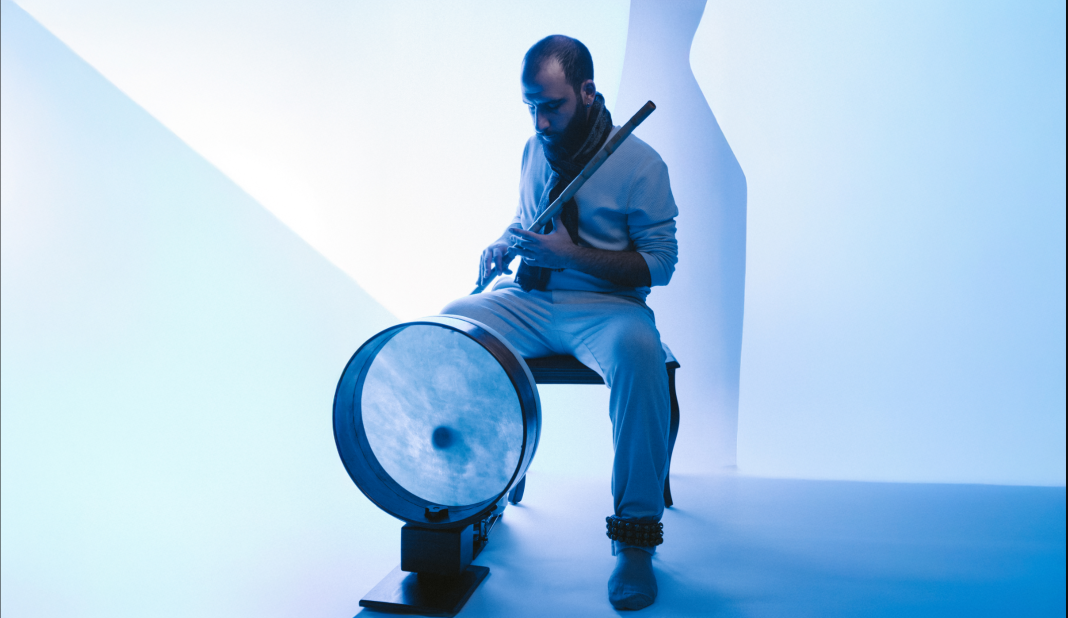
Born in Bethlehem, Palestinian virtuoso, global jazz flutist, composer, and certified music therapist Faris Ishaq has dedicated his career to pushing the expressive limits of the ancient Middle Eastern reed flute. He is an esteemed Berklee Global Jazz Institute graduate and fluidly combines Arabic maqam modal traditions with jazz improvisation, global rhythms and classical arrangements. What makes Ishaq special in the present music scene is his unique multi-layered acoustic performance style, where he supports his nay playing with simultaneous leg percussion and frame drum rhythms, without resorting to electronic effects or modern looping devices. His artistic evolution has been documented over the years on critically acclaimed albums such as Tripolarity (2019), Nature Addresses You (2021) and Kham (2023), and high-profile features on the Assassin’s Creed Mirage soundtrack and with jazz titans such as John Patitucci.
Faris Ishaq’s 2026 album, JASAD جَسَد, far beyond the synthetic noise and disembodied digital artifacts of our ever more synthetic world, is a profound testament to raw human existence. Derived from the Arabic for ‘Body’, this monumental work is more than a collection of musical recordings – it is an intimate manifesto of the physical vessel, a sacred convergence where breath, bone and ancestral memory come together. The album is inspired by the ancient art of Palestinian reed flutes through the prism of natural traditional flute melodies channeled through human respiration and organic physical movement. It is a work of seven chapters, exploring the meaning of carrying identity, heritage and quiet resistance within the physical body. A sonic language is forged, pure and unadorned, not with the embellishments of modern decoration, but to beckon the listener away from the distractions of the day into a sanctuary of pure truth.
The journey is inaugurated by “Ard,” a title signifying “Earth,” wherein the mortal vessel is immediately anchored to its fundamental origin through the resonant depth of traditional flute melodies. This opening movement is an evocative homage to the ancient folk tunes that have traversed geography and generations, carrying stories from Palestine to Jordan and Iraq. The physical soil is named not as an abstract concept distant away, but as a living being that breathes with humanity through the acoustic air column of the reed. The constant exchange of breath and physical movement sends spiritual consciousness into the dust and stone of ancestral land, raising a gut feeling that the body is not just traversing the land but is made up of this land, rooted in places beyond the power of external borders or whimsical relocation.
From this grounded basis, the story moves on to “Incense Trail,” a piece inspired by the deep Arabic conception of Qabas, the flickering, delicate spark of light that kindles an inner fire. Here a more gentle, meditative stance is taken as the essence of ancient trade routes and spiritual wanderings is evoked through delicate traditional flute phrasing. This sonic journey illuminates the inner landscape with a gentle but infinite glow, following the lines along which stories, traditions and silent longing once traversed great desert spaces. Throughout this movement there is expressed a deep inner change, a testimony that the spark of creation is an act of silent bravery, and that even in the darkest shadows, a single breath delivered by a natural cane can ignite an indelible flame.
In stark, poignant contrast to this gentle illumination, “Carved” comes as a tactile study in endurance and intention, expressed through piercing yet graceful flute lines. The third is the conscious making of oneself through suffering, the careful chipping out of each melodic phrase, each pregnant pause, as a sculptor chips away the superfluous stone to find the true form within. Raw breath dynamics inscribe pain, memory and dignity into the very acoustic atmosphere. It is a solemn reminder that human character is not a gift of chance but a product of living. In this movement, the space itself is held in complete regard for what is not said between notes of the flute can be just as powerful as the marks left upon physical stone.
“Fragments” shifts from structural shape into quiet vulnerability, naturally flowing into the delicate art of inner contemplation with soft, floating flute motifs. This fourth chapter is not a perfect whole, nor seamless, but it pays respect to the fragments of memory, desire and legacy that make up the modern. In a world that often requires hard-edged perfection, the reed’s subtle microtones create a compassionate space for the incomplete and the fractured. The listener is led across a landscape where silence and breath-fuelled melody are equals and where isolated moments of grief and joy can collect without coercion. And in this reflective atmosphere a tender truth emerges: wholeness is not the absence of brokenness, but the gentle gathering of scattered pieces into a unified sanctuary.
Entering into a world of universal resonance, “My Favorite Things” offers a revolutionary reinvention that links disparate cultural terrains through the authentic voice of traditional flute craftsmanship. The piece shows how familiar stories can be reborn when run through the filter of true personal truth, as it filters a globally known classic through the ancient, organic reed and the spirit of Palestinian heritage. A once playful thought, now made deeply soulful and emotionally complicated by the traditional embellishments that reshape the familiar melody. Here, in this rich dialog between international familiarity and rooted regional identity, real art is shown to have no hard boundaries. It shows how shared memory can be reclaimed, reinvented, and given new vitality when spoken in one’s authentic physical voice.
After a lively reinterpretation of a mutual classic, “Sukon,” which means “Stillness” or “Calm,” conveys a very peaceful mood through long, gentle fluting. Here in this tranquil refuge the rush and tumult of modern life are completely stilled, leaving but the pure, unadorned echo of air passing through natural cane. At the heart of “Sukon” is a gentle nudge to linger in the now, without fear or reservation. Tranquility is not a passive lack of noise but an active, brave movement back to the self, guided by the natural rhythm of breath. In these leisurely spaces the inner rhythm of the human vessel slows down so that peace is felt not just as an abstract thought but as a tangible physical reality within the body.
The album finds its final resting place in “Twilight,” the closing movement, which ties together the emotional threads of the entire journey in a haunting final flute dialog. As the light starts to slip into shadow, a meditative space is created, where introspective depth meets heightened hope. The conclusion is not an end but a natural threshold, a soft twilight in which the experiences of earth, spark, carving, fragmentation, memory and stillness are absorbed into one lasting spirit. The last dying notes hang softly in the air, forming a cyclical harmony that demands you to start over, etching itself into the heart and mind of the listener.
If we take a step back and look at JASAD as a whole, its essence is a vital, practical remedy for our modern daily lives. In a world where we are surrounded by screens and digital notifications, noise and daily stress, we often feel disconnected from our physical bodies. JASAD reminds us of the basic truths of human beings that help bring balance back into our everyday routines. It reminds us to physically ground ourselves in nature like “Ard,” to appreciate the quiet inner sparks that inspire us like “Incense Trail,” to view our personal struggles and imperfections as sculpting tools rather than failures through “Carved” and “Fragments,” and to build moments of quiet stillness like “Sukon” into our everyday schedules. The album teaches us that our physical body is our main home, showing us how to move through our day-to-day stress with newfound calm, grace and resilience.
A special listening environment is strongly advised for full appreciation of the depth and beauty of JASAD. Choose a time either in the early morning or evening, in a comfortable space and free from digital distractions. With high quality over-ear headphones or well balanced stereo speakers, you’ll hear every subtle nuance, from the soft texture of air moving through the reed to the organic sound of finger taps and physical percussion. By treating the album as a mindful, acoustic meditation rather than just background music, the restorative energy of the album can fully take effect. To summarize, JASAD جَسَد is a master class by Faris Ishaq, a timeless and deeply moving work that proves that even in a chaotic world true peace, ancestral strength and healing start with one conscious breath.
For more songs like this, follow Faris Ishaq on Spotify, Faris Ishaq on Bandcamp, Faris Ishaq on Facebook, Faris Ishaq on Instagram